
Introduction: The Spirit of M and the Carbon Revolution
For over half a century, the BMW M division has been synonymous with the philosophy of “form following function.” In the world of high-performance automotive engineering, every curve, every vent, and every material choice is a calculated decision aimed at one goal: shaving seconds off a lap time while maintaining a visceral driving experience. Central to this mission for the last two decades has been Carbon Fiber Reinforced Polymer (CFRP).
What started as a weight-saving measure on experimental racing prototypes has blossomed into the defining aesthetic and technical characteristic of the modern BMW enthusiast’s journey. Today, we explore the deep technical evolution of carbon fiber aerodynamics, from the legendary CSL models to the cutting-edge G8X platform, and why the material you choose for your build determines whether you are merely “styling” or truly “tuning.”
Chapter 1: The CSL Legacy – Where Lightweight Became Legend
To understand where we are today, we must look back at the car that changed everything: the E46 M3 CSL (Coupe Sport Lightweight). Released in 2003, it was the first mass-production BMW to utilize a carbon fiber roof, a feature that lowered the car’s center of gravity and became a signature of M cars to follow.
The CSL wasn’t just about weight reduction; it was a masterclass in aerodynamic integration. The iconic “ducktail” trunk lid and the asymmetrical front bumper intake were designed to balance airflow at speeds exceeding 150 mph. This era taught us that carbon fiber wasn’t just a decorative trim; it was a structural necessity for performance. At Carbonss Tuning, we still draw inspiration from these early designs, ensuring that our modern “CSL Style” components for the G8X platform carry that same racing DNA.
Chapter 2: The Technical Leap – From Wet Carbon to Dry Autoclave Technology
As the tuning industry matured, so did the manufacturing processes. Early aftermarket carbon fiber often relied on “Wet Carbon” techniques—hand-laying carbon sheets with liquid resin. While this achieved the look, it lacked the precision and strength required for true aerodynamic loads.
The modern standard, and the one we strictly adhere to at Carbonss Tuning, is Dry Carbon Fiber (Pre-preg Autoclave).
- The Process: Pre-impregnated carbon sheets are placed in high-precision CNC-machined molds and then cured inside an Autoclave under intense pressure and temperature.
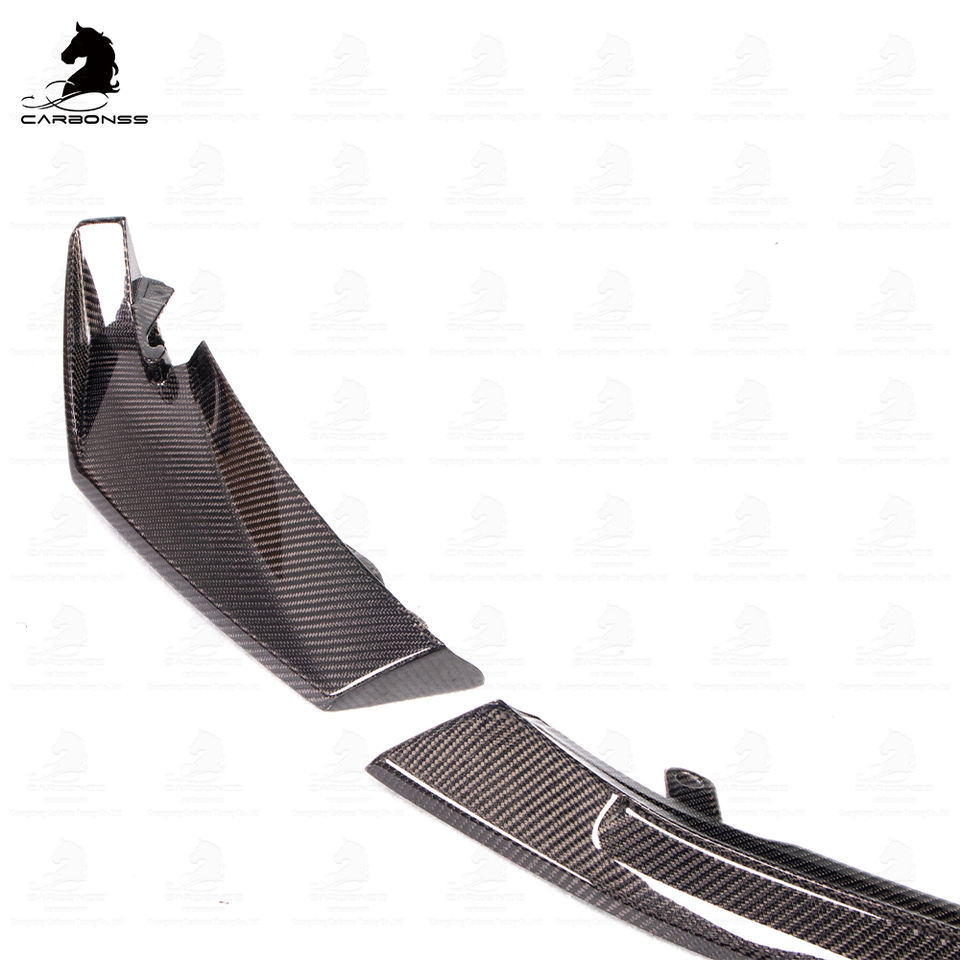
- The Result: This process forces out any air pockets and ensures a perfect resin-to-fiber ratio. Dry carbon is up to 70% lighter and significantly stronger than its “wet” counterpart.
- The Durability: Because of the high-density bonding, dry carbon parts are far more resistant to the extreme heat generated by high-performance exhaust systems and the punishing UV rays that typically cause inferior parts to yellow or crack.
Chapter 3: Engineering Downforce – The Physics of the G8X Platform
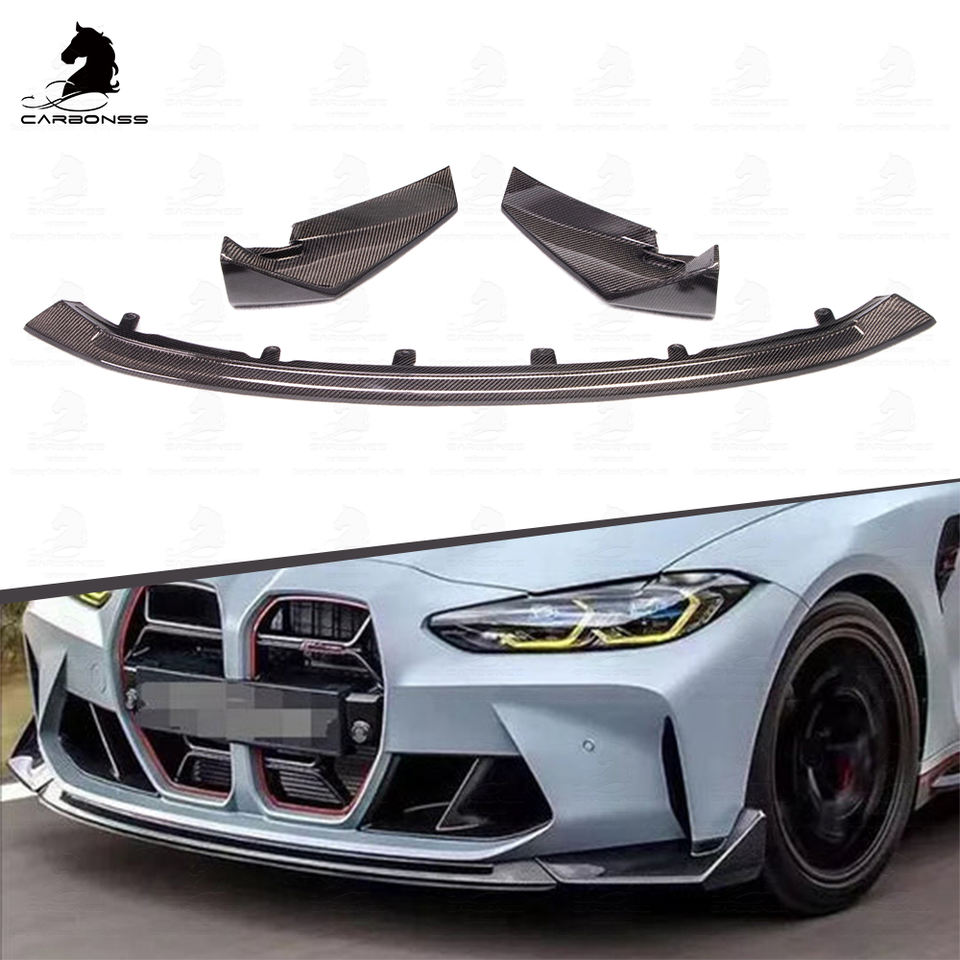
The current BMW G80 M3 and G82 M4 represent a significant departure in design language, featuring a larger frontal area and more complex air channeling requirements. Tuning the aerodynamics of a G8X requires more than just “adding a lip.”
Front-End Precision
A high-quality front lip spoiler, such as our V-Style or MHC-Style lips, acts as a “splitter.” Its job is to split the air at the leading edge of the car. By forcing more air over the car and less under it, a high-pressure zone is created on top, pushing the front tires into the asphalt. This reduces understeer and gives the driver more confidence in high-speed sweepers.
The Rear Diffuser: Managing the Wake
The rear diffuser is often misunderstood as a purely cosmetic piece. In reality, it is a critical component of the “Venturi Effect.” By expanding the air as it exits from under the car, the diffuser creates a low-pressure vacuum that “sucks” the car to the road. The vertical fins on a Carbonss Tuning diffuser are designed to keep this airflow laminar (smooth), preventing the turbulence that creates drag and instability.
Chapter 4: Structural Integrity & The Importance of 3D Scanning
One of the biggest pitfalls in the aftermarket world is poor fitment. A front lip that sits slightly crooked or a spoiler that has a 2mm gap isn’t just an eyesore—it’s an aerodynamic liability. At high speeds, uneven gaps can create “lift” or localized turbulence that vibrates and can eventually cause the part to fail or damage the factory bumper.
To combat this, we utilize OEM-grade 3D laser scanning. We scan the factory G8X bumpers to a tolerance of 0.05mm. This data allows our engineers to design mounting points that utilize the original BMW screw locations, ensuring a “bolt-on” experience that feels like it came straight from the factory floor in Munich.
Chapter 5: Aesthetics Meets Function – The Carbonss Standard
We understand that for the modern owner, the car must look as good as it performs. That’s why we finish all our parts with a premium UV-resistant clear coat. We offer a variety of weaves, from the classic 2×2 twill to the exotic forged carbon, allowing owners to customize their aesthetic without compromising the technical integrity of the build.
Furthermore, we are committed to an “audit-first” philosophy. Every part that leaves our facility is inspected for weave consistency, surface clarity, and edge smoothness. We believe that if you are putting a part on a $100,000 performance machine, that part should be a work of art in its own right.
Conclusion: Crafting Your Legacy
Tuning a BMW M car is a journey of refinement. It is about taking an already incredible machine and tailoring it to your specific driving style and aesthetic vision. Whether you are building a dedicated track weapon or a weekend show car, the principles of aerodynamics and material science remain the same.
By choosing high-quality, dry carbon fiber components, you are investing in the longevity, safety, and performance of your vehicle. At Carbonss Tuning, we are honored to be a part of that journey, providing the global Bimmer community with parts that define the modern M era.
This article was produced by the Carbonss Tuning Technical Team. For more information on our G8X and G87 development programs, visit our official store or follow our journey on social media.